Tuesday, 21 May 2013

A Brief History of Bridgend

Caroline Street, c.1900!

Bridgend: It's Name and Origins 

Human habitation of the area goes back as far as historians have been able to perceive. Evidence remains in the form of the Round Barrows, Pond Cairn and Simondstown Cairn in Coity - with their significant proof of early use of coal and cereals; Bronze Age burial mounds on Stormy Down; Iron Age Forts at Dunraven; Flint Arrowheads found on Merthry Mawr Warren together with traces of primitive smelting hearths of the Iron Age and the Standing Stone at Sunnyside, beneath which were found cremated remains from the New Bronze Age. c.1500BC.

The Romans came here but left no military encampments, though several coins and artefacts have been found especially along the Roman military road from Isca (Caerleon) to Nidom (Neath), which skirts the town to the south. This important means of communication - at a much later date - was a major factor in the founding of the medieval settlement which gave birth to the town today.

The present name of the town is authentically derived from the name 'Brynggen Eynde' and is mentioned in a document dated 1444 - soon after the first bridge was erected (1425). The name evolved over many year until the present day version of Bridgend and its Welsh equivalent of Penybont ar Owgr.

Bridgend: It's History 

The original medieval settlement was on the banks of the 'Ogmore,' (the river's name comes from the combination of two words; the Welsh for salmon - Eog and the old Welsh word - Mor which nowadays refers to the sea, but formerly referred to 'any expanse of water,' such as an estuary or lake). In all early Norman documents it is referred to as 'Oggrmor,' 'Uggemore' or 'Ogmore' but never the doubtful version - Ogwr.

11th Century 

From its origins to the Norman Conquest from about 1093, when southern Glamorgan was occupied as far as their first 'frontier' on the line of the River Ogmore, the district was ruled by the Welsh Prince Morgannwg under tribal laws.

The Normans introduced  their own rules under Robert Fitzhamon,w ho established himself in Cardiff as Lord of Glamorgan. He divided the occupied are into Lordships, each governed and administrated by on of his senior knights. From the division came the tradition of the 'Twelve Knights,' among whom William de Londres held the great Lordship of Ogmore, and Payn  D'Urbervill (later Turbervill) gained the upland Welsh Lordship of Coity, Newcastle was held at first by Fitzhamon but later becaome a Turbervill manor.

The Welsh to the North and west 'frontier,' continued to raid and pillage the Norman occupied lands. That led to chains of boroughs being established throughout Norman held Glamorgan in order to protect the trade of the district and the merchants who came to the marts. Castles built in our area include Coity; Ogmore; Newcastle; Candleston; Brocastle and Old-Castle Upon-Alun. The Normans also brought to the area thier art of building in stone - churches, priories, abbeys as well as castles. As devout acts, they set about linking local traditional Celtic Churches with monastic foundations already flourishing in the Norman occupied english territories.

12th Century 

Thus by gift of Maurice de Londres - Lord of Ogmore - in 1141 the church of St. Michael of Ogmore became the beginning of the Benedictine Priory of Ewenny, granted to the Abbey of St. Peter of Gloucester, together with the churches of St. Brides Major, St. Michael of Colwinston and the manor of Lampha.

15th Century 

The rebellion by Owen Glendower (Owain Glyndwr - the self proclaimed Prince of Wales) against Henry VI, started in 1401, causing great damage to many Norman strongholds, churches and farms in the area, including the destruction of the Manorial mill at Ogmore (later the 'Watermill'); Blackhall at St. BrideMajor and the Church of St. Leonard, Newcastle (later St. Illtyd).

Coity Castle, under Sir Lawrence Berkrolles, was besieged by Glendower's forces, only being relieved by the King's forces. it was one of the few castles to hold out against Glendower.

The excellent ford below the rock of Newcastle, with its form ground approaches, provided the essential link between "Old Town" (Hendre) - later corrupted to Nolton - and Newcastle whose steep hill provided the route of further travel west and north.

 c.1425 a stone bridge was built alongside the ford - it being the first substantial bridge over the River Ogmore and from which the town's name is derived. Its narrow and humped outline is as it is today, but it was partially demolished by a great flood in 1775, when the two arches nearest the west bank were washed away. They were replaced by a large single span. The ford continued to be used by wheelchair traffic.

The ancient road which lead from 'Old Town' to the 'Bryggen Eynde' and across the river, passed through Elder Street - Bridgend's oldest street, still in use. Lying in two parishes - Newcastle and Coity and divided by the River Ogmore, the future town also lay in portions of two district manors, so its development years it never possessed town records!

16th Century 

In 1500 the town was noted as having a market repute, for it was the natural focal point of the fertile area to the south east and the south west; the valleys and hill farms converging from the north.

18th Century

During the latter part of this century saw the growth of the tanneries and the short - lived but ambitious woollen factory; the potteries on the clay beds of Ewenny ad Heronstone, also, in the town itself, the support services for agriculture, with an iron foundry making implements and farm machinery. 

Dunraven Place, c.1900!

19th Century

Iron founding and coal mining developed in earnest at the beginning of the century, but Bridgend stood outside the southern limit of the coalfield and retained its essential agricultural market character, as well as being the shopping and business centre for the coal mining valleys. In 1839 the Bridgend Railway was opened; a horse-drawn tramway which branched from the Dyffryn Llynfi and Porthcawl Railway of 1828 and survived for 30years bringing coal from the upper end of the Llynfi Valley.

Brunel's South Wales Railway opened its Bridgend station in 1850. The Vale of Glamorgan line of the Barry Railway was built in 1897.

New roads to Cowbridge and Aberkenfig together with a new traffic bridge in the 1820'sand 1830's opened the town to more through traffic and much more trade ensued.

The area has also been an important centre of limestone quarrying and in particular for a famous building stones in a part of Bridgend known as Quarella. The last large building to be mainly constructed of this particular stone was St. Mary's Church, Nolton, completed in 1887,with its tall spire added in 1898.

20th Century

Bridgend entered this century developing quietly as a market town and residential area depending on surrounding agriculture and the business brought by coal mining in the northern valleys.

The first bus station in South Wales was opened from 1923 and in the same year the local railways became part of the Great Western Railway Company. The town's change of character dates from the building of the vast Royal Ordnance Factory at Waterton immediately before the outbreak of World War II. Post war development included the conversion of this huge munitions factory into an impressive industrial estate including the European manufacturing base of the Sony Company; together with the nearby industrial developments  such as the highly successful Ford  Motor Company's Engine Plant and the Science Park (which houses the international companies Align Rite, Biotrace and others). Bridgend boasts a well developed manufacturing and service sector that is world renowned.

The completion of the M4 Motorway from Lonodn to Pont Abraham (West Wales) and the dual carriageways to Junctions 35,36 and 37, the town's railway Intercity link and the facility of Cardiff International Airport (just 12 miles away), and the continued redevelopment of the five major seaports (all provided in recent years) has made the town and the surrounding area very accessible.

Adare Street, c.1904!


Sunday, 19 May 2013

Ffaldau & Garw Collieries

Ffaldau Colliery, c.1970's!


The Ffaldau Colliery

Sinking operations at the Ffaldau or 'Ffalda' Colliery began in June 1878 in the hope of locating steam coal measures under the estate of the Earl of Dunraven. By 1878 the colliery was in full production under the supervision of Edward Plummer, and within four years the mine was employing between 300 and 400 men and producing 400 tons of coal a day.

At the turn of the century the Ffaldau Colliery was firmly established and was continually introducing intricate technology to maximize production. The colliery management adopted such innovations as the Belgian Coke Ovens, the first of their kind in Mid-Glamorgan, and the 'Siemens - Shuckerts' aerial ropeway which removed waste from the colliery site to the hilltop directly above.

The introduction of technological innovations became commonplace during the 20th century and virtually turned the colliery into an industrial guinea pig. Following the nationalisation of the industry in 1947 the Ffladau Colliery was one of the first in South Wales to undergo a major modernisation programme.  The reconstruction work was completed in June 1949 at a final cost of £966, 623 and resulted in an increase of production from 340 tons to 1200 tons a day.

In spite of its modernisation programme, by the 1970's the pit had became uneconomic to maintain since the areas it worked underground could easily be managed by the a Ocean Colliery in Blaengarw. As a result, the two collieries were merged in 1975 with all surface handling facilities and administration being undertaken by the Ocean Colliery.


The Ocean (Garw) Colliery

During the early 1880's David Davies M.P. owner of the Ocean Colliery Company, took out a lease from the Dunraven Estate to establish a Colliery at Nanthir. By September 1886 coal was turning out well from the colliery and it was heading towards full production. In the early 1890's the Ocean Company had grown into the largest mining concerns in South Wales and the Garw Colliery itself had increased its work force to 500 men and had obtained an average daily output of 800 tons.

The Garw Colliery continued production throughout the 20th century absorbing the workforces of all the other collieries in the valley until it remained the only one. By the 1980's it too was fighting for survival, culminating in th long and bitter coal strike of 1984 which finally sounded the death toll for the industry. In December 1985 the National Coal Board closed the Garw Colliery and removed the lifeline that had sustained the valley for over a century.

Workers of The Garw Ffaldau Colliery!


Thursday, 16 May 2013

Bridgend on the Map!

Whilst researching for an archaeological project I am involved in, I came across a few maps. I thought I'd share them with you!


This Map is entitled "Britannia" by William Camden (1551-1623) is dated 1610! It shows Glamorgan as the land of the Silures. 


‘Silures’ were a powerful tribe that existed during the time of ancient Britain, occupying Glamorganshire and Breconshire amongst other areas of South Wales, and it is thought that they also held occupancy in Gloucestershire and Hereforshire. The ‘Silures’ in this area of Glamorgan were led by Bodvoc, the son of Caitegern. The ‘Silures’ made a fierce resistance against the Roman invaders including imprisoning them and taking some as hostages.


This Map entitled 'Anglia regnum' was created by Willem Janszoon Blaeu (1571-1638) during 1634. On this map we can clearly see Bridgend and it's surrounding towns. 


This Map is entitled "A new mapp of the kingdome of England, representing the princedome of Wales, and other provinces, cities, market towns, with the roads from town to town and the number of reputed miles between them, are given by inspection without scale or compass" was created by Nicolaes Visscher (1649-1702) - Although the map is undated, we know it is of lae 17th century creation! On this map we can clearly see Bridgend and it;s surrounding market town: including Cowbridge and Caerphilly. 

Part of the Key!
This Map is entitled "A new mapp of the kingdome of England and Wales: containing all the cities, market towns, with the roades from town to town, and the numbers of reputed miles between them, are given by inspection without scale or compass New mapp of the kingdom of England and Dominion of Wales New map of the kingdom of England and Dominion of Wales New map of the kingdome of England and Wales" and was created in 1689 by William Berry (1669 - 1708).

Again on this map we can see Bridgend and it's surrounding areas!


 This Map entitled "South Britain or England & Wales : drawn from several surveys &c. on the new projection, corrected from astronomical observations, & the places marked where the observat. were made England & Wales South Britain" was created by Thomas Kitchin (d. 1784)  and published by Robert Sayer (1725-1794) on January 1st 1787

On this map we can see Bridgend and its surrouding areas in more detail. We see that places such as: Newton, Pile, Laleston and Nash Point have now been added!


Thursday, 11 April 2013

Victorian Bridgend: Memories of the Town

Nolton Street, c/1900!


I was kindly donated the memoirs of a lady who grew up in Victorian Bridgend! - I though I'd share a few extracts with you.

Her first school in 1893 was  in a house still standing at  the bend of Cowbridge Road with Nolton Street, it  seems to have been a private nursery class although far removed from the "learning through play" of today .Miss Francis ,who ran it with her sister, had been a pupil teacher at the Board School in Freeschool court.

The school classroom was held in the front room of the house and the children sat on two rows or wooden, forms , with no back rest ,as they were always supposed to sit up straight to develop good posture while at the rear of the room there was a "gallery". a raised platform. When the children came to school they had to curtsy and say "Good Morning Miss Francis".They would then stand around the harmonium and sing a hymn followed by a prayer.Next they would be given a slate and chalk and learn how to form letters with neat pot hooks, and write, "up slanty and thin, and down straight and thick".

Once a week as treat ,they were taught to knit using whale bone needles and string.
Miss Francis seems to have been to be quite a fashionable lady as on Church going days she wore a very long dress, which was always trailing on the ground, while on her head there was a hat with a great big feather in it.

"When we were girls waists were 21inches ,and there was some pulling in of stays, young ladies were always fainting in Church  then I can tell you".
 
Alice then went on to the Board School in Brackla street where her most vivid memory was of standing in the school yard to watch Mrs John Randall placing the foundation  for the weather cock on the spire of Nolton Church. Apparently there was a lift or type of wooden cage attached to the scaffolding .Mrs Randall, her husband and the foreman landed on a platform ,then climbed a ladder to the top of the spire, where Mrs Randall spread cement and set the top stone in place.The next week, after the cement was set ,the weather cock was fixed there, presumably by someone other than Mrs Randall!

The school itself appears to have been run on rather authoritarian lines as the "Master" seems to have spent a good deal of time on caning errant boys,. the Mistress too was not averse to caning girls, although on the hands, and usually for some thing trivial like forgetting a handkerchief.

In c.1895 there was a very severe winter, and the men who worked in the Quarry had to stop work for six weeks. Soup kitchens were set up as no work meant no pay in the days before unemployment benefit.
The River Ogmore was frozen over and people were able to skate on it. One man a Mr Mc Gaull, who lived near the river, had a very narrow escape when he fell through some thin ice.

Nolton Street seems to have been largely composed of small shops and houses. One lady who would have lived opposite where  the Rhiw Arcade is now, used to take a chair on the grass outside her front door,where she sold sand to people wishing to keep a clean doorstep; another lady Miss McClellan had a sweet shop where one could have a farthingsworth of sweets or a sugar mouse for a halfpenny

Sunday, 7 April 2013

Victorian Bridgend: Newspaper Articles

Nolton Street c.1900


Whilst researching Victorian Bridgend I came across this wonderful website: Welsh Newspapers Online
This website, which is run by the National Library of Wales consists of Welsh Newspapers from 1844 - 1910!

I have found during my research, that Victorian Bridgend seemed to be a lively place! There was always something going on,  horses on the loose or pick pockets on he prowl! I would recommend the Welsh Newspapers website to anyone who is researching local welsh history. It is honestly a great insight into the lives of our ancestors

I have chosen a few interesting articles to share with you :


1892: BRIDGEND. SCHOOL TREAT
The annual treat, in connection with the English Congregational Church, Bridgend, took place on Monday at Ogmore. There were about 240 present, and a thoroughly enjoyable d>iy was spent.

1891: BRIDGEND. MUSICAL FESTIVAI.
 On Monday a Wehh musical festival was held at Hermon Calvinistic Methodist Chapel, Bridgend, when a choir of about 850 voices (from the connexional Churches of Bridgend and Ogmnrè and Garw districts), con- ducted by Mr. It. Prosser (” Eos Cyntais”), Treorky, rendered a number of hymns, chants, and amhuma, services heiug held throughout the day. The chapei was crowded ateacb meet* iag.

7th January 1871: BRIDGEND. COUNTY BALL
The annual County Ball was given on Wednesday night. The Town Hall was beautifully decorated for the occasion. Most of the principal families in the county were represented. There seemed to be a slight falling off in the attendance however to former year?. Mr. Watt, of the Wyndham Arms Hotel, catered in his usual excellent style.

28th July 1893: DASTARDLY OUTRAGE AT BRIDGEND. ATTEMPT TO BLOW UP A HOUSE.
 At about two o’clock on Tuesday morning a diabolical attempt was made at Bridgend to blow up the front portion of Mr. Morgan Williams’ residence in Ewenny-road with gunpowder. The powder appeared to have been placed in a couple of sacks on the sill of the drawing-room window facing the street, and fired by means of a fuse. The explosion instantly aroused Mr. Williams and his neighbours, who found, however, that very little damage had been done, only the windows being cracked and the framework slightly damaged by the flames. The significance of the outrage is increased by the fact that only a fort- night before an attempt was made, under cover of night also, to set the front door on fire with paraffin. The perpetrator has, so far, not been discovered. Mr. Williams, who is surveyor to the Local Board, and has only recently come to the town, is at a loss to explain the motive of the out- rage.

13 November 1891: THE STORM
A severe storm, accompanied by heavy rain, raged over the town on Wednesday last. Slates were blown down in several parts of the town. A chimney over Mr. Bird’s premises, in Caroline-street, was blown down, and a voting man passing at the time narrowly escaped injury from the failing stones, his hat being knocked off by one of them.

26th August 1892: A FALSE RUMOUR
About eleven o’clock on Saturday night it was rumoured in the town that a man up Nolton-road had had his eye knocked out by another man in a fight, and large crowds gathered about the scene of the alleged occurrence. Police- constables Sloley, Brown, Brinson, and Sandford were quickly upon the spot, and maintained order. Upon enquiring further into the matter, the police judged that it was a case in which the injured party should be left to take proceedings himself if he thought proper, and they consequently did not take the aggressor into custody. It was found that the man’s eye had not been knocked out, as rumoured, but that Lis face had been cut—it is alleged-with a spur.

16 December 1891: A RUNAWAY
One day last week, while Mrs. Thomas, Twmpath Farm. Colwinstone, was driving into town, and when near the Coach and Horses public-house, the horse, attached to the trap, took fright, and went at a galloping pace through Nolton- street, breaking a shaft on the way. Keeping straight ahead Sergeant Rowe, who stood on the police-station door, rushed to the back of the trap, and by combined force and strategy, succeeded in arresting and stopping its progress when near Mr. E. Phillips’ works, about 60 yards distant. Mrs. Thomas was then assisted out of the trap greatly frightened, but fortunately un- hurt.

Saturday, 6 April 2013

Brynteg Comprehensive School and It's Crest

Brynteg House. 1923!

Brynteg Comprehensive School, one of the largest secondary school in Wales is situated on Ewenny Road (B4265) opposite Heronsbridge School.

The County School for Boys was officially opened on the 26th of September 1935.  The total cost for the new buildings was £25,000 this included a Gymnasium, a large Assembly Hall, dining room and kitchen,  Art Room,  a Staff Room, two large cloakrooms, a Library, Offices, eight Classrooms and four fully equipped laboratories (two for Chemistry and two for Physics).   These were all arranged around two quads that were either side of the Assembly Hall. The new buildings also embodied balconies which are supported by metal columns giving access to the second floor.

As a result of the Butler Education Act, in 1944 The County School for Boys became the Bridgend Boys Grammar School. At the same time the Pen-y-bont Senior School for Boys (at Heol Gam – Brynteg Lower) became a mixed gender Secondary Modern (opened in 1948).

Pupils of Heol Gam Secondary Modern, 1959.


Staff at Brynteg, 1989.
Due to the 50% increase in pupils (following the closure of the Bridgend Technical College) , in 1959 a second wing was added to the Grammar School.  The new block was a three storey steel and concrete construction that was connected to the earlier building via a bridge.

During 1971 the Grammar Scholl and Heol Gam Secondary Modern merged to form Brynteg Comprehensive School, with the Grammar School becoming Brynteg Upper School and Heol Gam becoming Brynteg Lower School.

Notable former pupils of Brynteg include: Nicole Cooke (Olympic Champion) , Carwyn Jones (First Minister for Wales), Gavin Henson (Rugby Player), Prof Keith Burnett (Professor of Physics at the University of Oxford & Vice Chancellor of the University of Sheffield), and Paul Burston (British Journalist & Author).

 Brynteg also has very strong Rugby connections with Gavin Henson, Robert Howley and Kevin Ellis all attending the school.

Brynteg’s Crest 

The crest which can be seen on the pupils jumpers, homework diaries and sixth form ties was created by a previous Art Master named David Thomas.

The crest includes the cross of St David (the Welsh patron saint), The Coat of Arm’s of Glamorgan from the de Clare family who held the Lordship of Glamorgan throughout the 13th century and the first part of the 14th century and the Coat of Arms of the de Turberville family who held the Lordship of Coity throughout the late 11th century, 12th century, 13th century and the best part of the 14th century.


The Lordship of Glamorgan

The lordship of Glamorgan was few established during the Norman conquest. The powers that came with this role included:

  • He/She could declare war
  • He/She could raise or lower taxes
  • He/She could establish courts
  • He/She could build a castle wherever He/She pleased without the reference of the crown. 
These privileges were then lost under Laws in Wales 1535-1542. The main seat of  this Lordship was held at Cardiff Castle.


The First Creation of the Lordship of Glamorgan:
  • Robert FitzHamon (1093-1107)
  • Robert 1st Earl of Gloucester (1118-1147)
  • William FitzRobert, 2nd Earl of Gloucester (1147-1183) 
  • Isabel, Countess of Gloucester
The Second Creation of the Lordship of Glamorgan: 
  • Gilbert de Clare (1217-1230)
  • Richard de Clare (1230-1262)
  • Gilbert de Clare  (1262-1295)
  • Ralph de Monthermer (1297-1307) 
  • Gilbert de Clare  (1307-1314)
  • Eleanor de Clare (1292-1337)

As you can see the Lordship of Glamorgan stayed with the de Clare family throughout the 13th century and the first part of the 14th century.
 

The de Turberville family


During 1100 a stronghold at Coity was completed. The Castle was built on the site of an earlier Welsh Court. It was of a timber and earth work constructed and later fortified to stone. The notorious de Turberville family held the castle at Coity for many years. The de Tuberville family held the Lordship of Coity from c.1092 until c.1380. The Lordship is thought to have been founded by Sir Payne de Turberville, who was one of Robert FitzHamon’s Twelve Knights of Glamorgan along with William de Londres who held the Lordship of Ogmore.  He was given this Lordship in return for his services during the Norman Conquest.

The Turberville Lordship was ended by the death of Richard Turberville, Sir Payne de Turberville's 6th great grandson. He left no male heiress, leaving his sisters as four co-heiresses. His eldest sister Katherine married into the Berkerolles family which led the Lordship to be taken up by their family.

The descendants of Sir Payne de Turberville came to own Sker House during the late 1500’s. The family played a very important part in the affairs of the county as they had held the Lordship of Coity many years before.

Sker House


Bridgend: A Short History (1100 - 1950)

Dunraven Place, c.1880's.


c.1100 
The building of a stronghold at Coity had began. The building was carried out on the site of the earlier Welsh Court House of Morgan ap Meurig.  Morgan’s daughter later became the wife of Sir Payne de Turberville, who held the  Lordship of Coity. Thought to have been originally made of  timber, the stone construction was not completed until the time of Gilbert de Turberville.


1106
One of the first recorded references to Newcastle appears as a  confirmation by Henry I of grants by Robert FitzHamon to the Abbey of Tewkesbury includes a reference to “ECCLESIA DE NOVA CASTELLA” - It is thought that the ‘new’ castle existed 50years prior to the stone castle being built.


1116
Ogmore Castle is recorded to be in the possession of William de Londres  and the record confirms that the early castle had been built by this date. It was a motte and bailey type castle, which was made from timber. The stone castle was built soon after and it thought to have been completed by Maurice de Londres, the son of William.


1184 
According to Giraldus Cambresis, Arch Bishop Baldwin ‘passed by the little cell of Ewenni (Ewenny)’ - he did this on his pilgrimage through Wales. He was doing this to raise support for the crusades, and was making his way to stay at Margam.

1199
The first recorded reference to Nolton, a name found in several locations which in Old English meant an old farm/settlement.

c.1200
The Triangle Defence of Ogmore, Newcastle and Coity becomes the Ogmore Quadrilateral after fortification of Ewenny Priory.

1217
Newcastle is granted to Gilbert de Turberville (2nd Lord of Coity) through his marriage to one of the daughters of Morgan Gam. Morgan held the fee of Newcastle under King John.

1284
King Edward I stayed at Ewenny Priory in the December of 1284. He was on his way to Cardiff Castle.


Ewenny Priory

1322
The Lordship of Ogmore became part of the Honour of Lancaster.

1325
It is thought that St Marys Church, Coity was completed around this time.

1360
With the death of Richard Turberville the male line of Turberville Lordship of Coity ended.

1404/05
Coity Castle is attacked by the forces of Owain Glyndwr. The manorial mill at Ogmore was destroyed along with Newcastle Church and Castle being severely damaged. 

1411
The  death of Sir Lawrence Berkrolles arouses suspicion that he was poisoned by his wife.

c.1425
The Old Stone Bridge (Bridgend) is built.


1444
One of the Earliest references to Bridgend - given as “Bryggen Eynde“ . It refers to a small settlement that appeared at the eastern side of the bridge. I.e. Elder Street and Nolton Street.

1452
A further reference to Bridgend - given as “ BRUGEENDE-JUXTA-COYTIF” meaning “The Bridge near Coity”.

1534 
Dompmus Thomas, the last Prior of Ewenny signed a submission of King Henry VIII which led the monks being forced to leave.

1536
After the dissolution of the monasteries, the Rectory and tithes of Newcastle were sold to a Sir Rice Mansel. It remained pat of the Margam Estate until the redemption of the tithes.

1541
Sir Arnold Butler of Dunraven died, he was the last of the male Butler line. The Butler family had owned the manor since Arnold le Boteler (Butler) received it  from the de Londres family as a reward for protecting the castle of Ogmore while the Lord was away. 


1578 
Rhys Meurig included Bridgend in his list of “Seven Dangerous Places Sometime in Glamorgan”.

1584
On the 28th of September, 1584 the commission of Queen Elizabeth was held at Bridgend. The aim was to make inquiries into the ownership of the former Church lands.

1600/01
Evidence suggests that a woollen cloth was made and sold in Cardiff, Swansea and Bridgend. A complaint was made, the complaint being that the illegal use of an official seal on cloth made contrary to statue by the officer for the inspection of woollen cloth, his name was Hugh George.

1632
Court of Survey for the Lordship of Ogmore is held at the Court House situated in the Ogmore Castle grounds.

1645
Colonel Edward Carne of Ewenny Priory was made High Sheriff of Glamorgan by Oliver Cromwell.

1648
Royalist forces are defeated at the Battle of St Fagans.

1675 
A report from the Welsh Trust shows that twenty pupils enrolled at its Charity School in Bridgend.


1706/11
Michael Williams had a “flourishing” tannery in Bridgend.
(The location remains unknown.)

1723
Dr Richard Price is born at Tynton, Llangeinor.


1737
Two ships by the names of ‘Pye’ and ‘Priscilla’ were wrecked near Nash Point. They were both subsequently looted by gangs some thought to have been from Bridgend.

1741
Rev. Howell Harris stayed at Bridgend with Rev. Lewis Jons. Rev. Harris preached at ‘The Meeting House, Newcastle’. It is also thought that ‘The Meeting House, Newcastle’ is the burial place of Catherine Thomas (Nee Price) The Maid of Cefn Ydfa’s mother. We do not have any evidence to support this claim.


1750
David Munday, the earliest recorded Clock Maker in Bridgend, began his business.

c.1760
Walter Coffin the 2nd founded his tannery beside the river bridge at Sunnyside, Bridgend. His tannery became famous for it’s high quality leather. His leather was in great demand over a wide area.


1767
Richard Turbervill(e) of Ewenny Priory was returned as MP for Glamorgan at Bridgend.

1775
The Old Stone Bridge and its three main water arches were partially destroyed by a flood. The two arches nearest the west bank were carried away. The bridge was rebuilt soon afterwards.

1785
Dr William Morgan, FRS, of Bridgend publishes his paper on “Electrical Experiments Made To Ascertain the Non-Conduction Power of a Perfect Vacuum”.

1788
It is thought that the first Town Hall, Dunraven Place was erected in 1788.


1790
A ‘Spinning Jenny’ was acquired by the Glamorgan  Agricultural Society and was later installed in Bridgend.

1791
Dr Richard Price dies in 1791. He was buried at Bunhill Fields, London on the 26th April of that year.

1792
One of the earliest references to the Wyndham Arms Hotel. Recently evidence has come to light that there was actually a building of substantial importance on the same site during c.1500.


1795 
The Unitarian Chapel (The Meting House) was rebuilt.


1803
Dunraven Castle was built in place of Dunraven House on the same site.
The 4th Earl states that no professional architect was employed and that all of the plans for the work were drawn up by Mrs. Thomas Wyndham.


1808
The Ruhamah Welsh Baptist Chapel is erected at the top of Newcastle Hill, Bridgend.

1808
The Bridgend Woollen Mill was advertised for sale due to financial losses.

1810
Henry Verity founded a drapery shop in High Street (Dunraven Place), which was named ‘London House’.

1812
A National School movement was founded in Bridgend. Its aim was to help establish a school by voluntary subscription.

1814
Thomas Wyndham of Dunraven dies.

1822
Park Street was officially opened.


1826
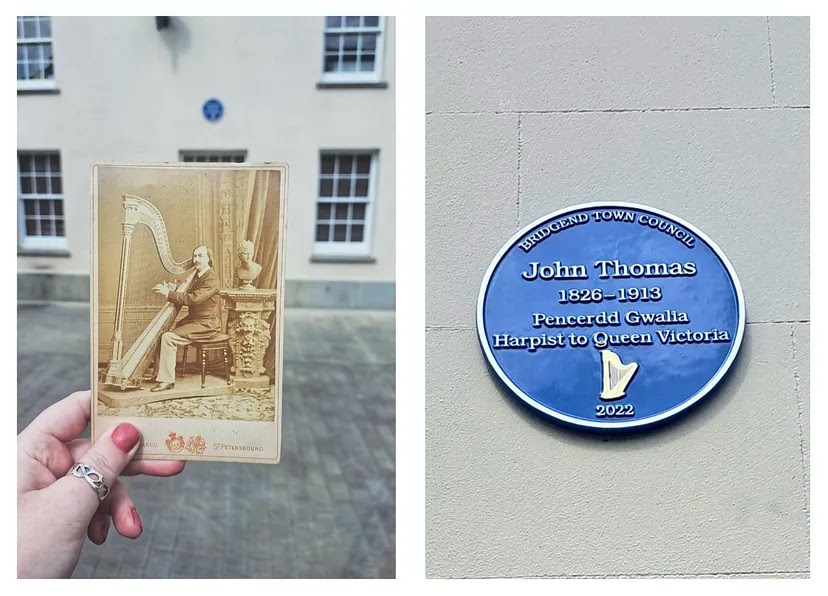
John Thomas, harpist to Queen Victoria was born on St. David's Day, 1826!


1828
The Duffryn Llynvi and Porthcawl Railroad was opened. It was built to carry coal from the upper Llynvi Valley to the new dock at Porthcawl.

1834
A Cholera was rife in the Bridgend district. It was thought to have mainly affected the people who lived on/near the banks of the River Ogmore.

1835 
A new Chapel-of-Ease was constructed at Nolton, on the previous site of  the Medieval Chapel in which John Wesley had preached in 1769 and 1772.

1836
The Poor Law Union of Bridgend and Cowbridge was founded.

1837
A new Market Hall, which was largely open-air was opened in Bridgend on the Lady Day of that year.

1841
In 1841 the decision was made for Bridgend to become the Headquarters of the Newcastle and Ogmore Police District.

1842
A Wesleyan Sunday School was established in ‘The Rhiw’ with thirty pupils.

1845
Bridgend Town Hall was erected in 1845 on land donated by the Earl of Dunraven. The hall was handed over to the committee of trustees on the May the first of that year! The first committee was held at the hall on the 2nd of June 1845. The Earl of Dunraven instructed that the land was to be leased to the town for 999 years and any building that was erected there was not to be used for political use.


1847
The Bridgend Police Station at the Town Hall , was lit by gas for the first time.

1849
The north aisle was added to added to St. Illtyd’s Church, Newcastle. The Church was later reopened by the Bishop of Llandaff in the December of  1850.

1850
The Bridgend Railway Station was reported to have been fitted with gas lamps on the 3rd of August, 1850.

1853
London House was sold to a Mr Thomas Hughes.

1863
The South Wales Rail Company was absorbed by the Great Western Railway.

1867
It was reported that several thatched cottages at The Square, Newcastle Hill were destroyed by a fire.

1887 
A new mental Asylum was built at Parc Gwyllt, Coity. This was because of the high demand for further accommodation.

1893
The Chancel at St. Illtyd’s was reconstructed and a Vestry was added.

1897
The Pen-y-bont  Main Sewage Board was formed.

1902 
A branch of Lloyd’s Bank was opened in Bridgend.

1908
The ‘Convention for Wales’ was held at Bridgend which was hosted by the National Council of the Free Evangelical Churches.

1910 
A new Science Block was opened at Bridgend County School.

1921
The Cenotaph War Memorial,  Dunraven Place was unveiled on Armistice Day.


1921
The Mid Glamorgan Water Board was formed.

1935
The new Boys’ School County School was opened on the former site of                                                                      ‘Brynteg House’.


1939
Two hundred Arsenal workers went on strike.

1939
In the January of 1939 a local haulier was fined not displaying lights on his horse drawn cart.

1939
Due to the weather, a Bridgend Arsenal worker died of Sunstroke.

1941
The Diphtheria immunization campaign began.

1948
The Royal National Eisteddfod of Wales was held at Bridgend.